


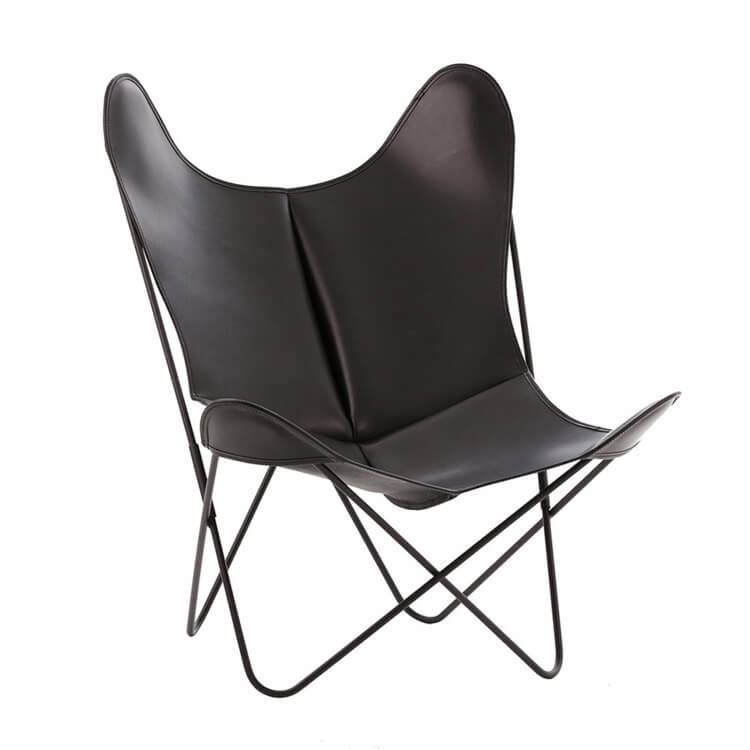
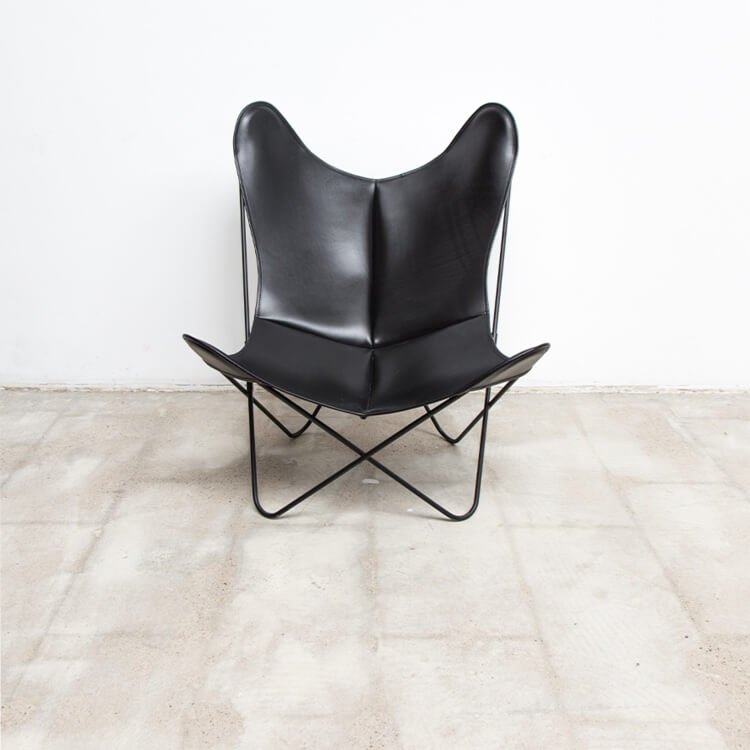




Butterfly Chair by Airborne (AA)
Airborne
- Description
- Dimensions
- Interview
Airborne is the exclusive manufacturer of the legendary AA chair, also known as the Butterfly.
In 1938, designers Kurchan, Ferrari-Hardoy, and Bonnet drew inspiration from the "Tripolina Chair" used by British officers in the 19th century. The Butterfly chair has since become a 20th-century design icon, notably featured in the permanent collection at the MoMA in New York (see below to learn more about the history of this unique piece).
The name "AA" is a tribute to Architecture d’Aujourd’hui, the oldest French architecture magazine.
-
Metal structures are guaranteed for 5 years by Airborne.
-
Leather models feature stitching that is guaranteed for life by Airborne.
The Butterfly chairs are delivered with a removable frame. Details:
-
Made in France
-
Finishes: 12mm steel wire frame with a matte black powder coating (RAL 9005).
-
Authenticity: Engraved with AA© followed by the year of manufacture (since 2011).
-
Included: The price includes the removable metal frame and the cover of your choice.
Leather Options
Smooth Leather:
-
A classic model with a "saddle" appearance.
-
Lifetime guarantee on stitching.
-
3.5 mm thick, vegetable-tanned leather.
Buffalo Leather:
-
Patina finish, more flexible with a slight grain.
-
Lifetime guarantee on stitching.
-
3.5 mm thick, vegetable-tanned leather.
Icelandic Sheepskin Cover
Made from genuine Icelandic sheep wool, this cover is dense, plush, and incredibly soft—a true cloud of comfort!
Shipping & Inquiries
-
Lead Time: Airborne chairs are made to order; please allow 4 to 6 weeks for delivery.
-
Custom Colors: If you are looking for other colors, please contact us at: design@coeurdartichaut.ca
:
Key moments in the history of the Butterfly chair

The Tripolina: A Nomadic Legacy (1877)
It all started with the Tripolina Chair, patented in 1877 by the English inventor Joseph Beverly Fenby. Initially designed for British army officers, it was based on a revolutionary concept for its time:
- Ingenious structure: A foldable wooden frame articulated by metal hinges.
- Suspended seat: A simple canvas slipped over the frame, offering unparalleled lightness and portability.
- Historical use: Adopted by the Italian (in Libya, hence the name Tripolina) and French armies for military campaigns, it invented the concept of the "suspended" and relaxed seat.

Austral Group: The BKF Revolution (1938)
In 1938, in Buenos Aires, three visionaries who had trained in Le Corbusier's Parisian workshop — Antonio Bonet, Juan Kurchan, and Jorge Ferrari-Hardoy — propelled this concept into modernity.
- Radical Innovation: The Austral Group replaced wood with a continuous steel tube and traded canvas for sturdy leather.
- The Birth of the BKF: Named after their initials, this chair created a real visual shock. Its sleek silhouette gave the impression that the seat was floating in space, marking the dramatic entry of organic design onto the world stage.
Regarding the image on the left, LIFE cover, 1966, Fundación IDA. On the right, BKF armchair, Austral Group, 1938, Museu del Disseny, Barcelona.

Airborne: The "AA" and "Butterfly" Myth (1951)
It was in 1951 that the story took on its French accent thanks to the company Airborne, under the impetus of Charles Bernard.
- The French Boom: Airborne produced the model and propelled it to the top of post-war trends. Its success was immediate in the most avant-garde interiors.
- The "AA" Christening: The name "AA" was chosen in homage to the cult magazine Architecture d’Aujourd’hui and its director André Bloc, a fervent defender of this iconic line.
- A Poetic Nickname: Quickly, its shape evoking outstretched wings earned it the name "Butterfly" internationally and "Papillon" in France, solidifying its status as a cult object, synonymous with freedom and lightness.

The Butterfly Chair at MOMA New York
1941: The Butterfly Chair's first major appearance in the "Organic Design" exhibition.
1942-1943: Featured in the "Useful Objects in Wartime" exhibition, highlighting its ease of manufacture.
Permanent Collection: It is listed as the "Hardoy Chair" (inventory number 110.1944).

The Butterfly chair and the Cannes Film Festival
Sophia Loren, the great Italian actress, poses here on a Butterfly chair in 1955 during the Cannes Film Festival

Other museums who are talking about the Butterfly:
The Musée des Arts Décoratifs (MAD) in Paris preserves historical examples, notably those with a black steel structure and canvas or leather cover, representative of French design from the 1950s.
The MAMBA (Museo de Arte Moderno de Buenos Aires) is also an essential conservation site for this model, as it was created in Buenos Aires in 1938. The chair is exhibited there as a fundamental pillar of Argentinian and global industrial design.
Airborne's Butterfly chairs in their element


As seen in the press

Some links to learn more about the Airborne Butterfly chair:
Press: Butterfly chair: the armchair that had wings
Ideat: The BKF or Butterfly armchair by Austral, an icon of Catalan design


